Spring源码学习(三)炒鸡丁与populateBean没区别

文章目录
逻辑说明
populateBean的流程
炒鸡丁的流程
1.执行InstantiationAwareBeanPostProcessor
的postProcessAfterInstantiation
(在设置属性前去修改Bean的状态,也可以控制是否继续填充Bean)
作为一个已婚男人炒菜之前,请示老婆,这很重要。
我:“我炒宫爆鸡丁了,有特殊要求吗?”
老婆大人:“没有要求,炒吧”。
2.注入属性到PropertyValues中(autowireByName/autowireByType)
初步准备食材
准备鸡肉,郫县豆瓣酱,花生米,黄瓜
3.执行InstantiationAwareBeanPostProcessor的postProcessPropertyValues,
对解析完但未设置的属性再进行处理
切菜 鸡肉切丁,黄瓜切小块。
4.对dependency-check属性的支持,默认是不校验
5.将PropertyValues中的属性值设置到BeanWrapper中
下锅,炒熟出锅
autowirebyType的大致逻辑
看了源码总结如下:
- 不处理简单属性,即不处理:Enum,CharSequence,Number,Date,URI,Locale等。(具体可以查看org.springframework.beans.BeanUtils#isSimpleProperty这个方法。)
- 不对Object类型的属性进行自动注入, 没有意义,技术无法实现
- 解析依赖resolveDependency并设置到pvs中
- registerDependentBean 注册当前依赖。
autowiredByType的源码注释
/**
     * Abstract method defining "autowire by type" (bean properties by type) behavior.
     * 抽象方法 定义 按类型注入
     * <p>This is like PicoContainer default, in which there must be exactly one bean
     * of the property type in the bean factory. This makes bean factories simple to
     * configure for small namespaces, but doesn't work as well as standard Spring
     * behavior for bigger applications.
     * 类似PicoContainer(非常轻量级的Ioc容器),beanFactory中一个属性类型必须有一个确切对应的bean
     * bean工厂很容易配置小的命名空间.
     * @param beanName the name of the bean to autowire by type  需要按类型注入的BeanName
     * @param mbd the merged bean definition to update through autowiring   合并后的BeanDefinition
     * @param bw the BeanWrapper from which we can obtain information about the bean  BeanWrapper对象
     * @param pvs the PropertyValues to register wired objects with 注册属性的属性值
     */
    protected void autowireByType(
            String beanName, AbstractBeanDefinition mbd, BeanWrapper bw, MutablePropertyValues pvs) {
        //获取类型转换器
        TypeConverter converter = getCustomTypeConverter();
        if (converter == null) {
            converter = bw;
        }
        //获取需要 注入的 非简单类型
        /**
         * 简单类型,详见
         * @see org.springframework.beans.BeanUtils#isSimpleProperty
         */
        Set<String> autowiredBeanNames = new LinkedHashSet<>(4);
        String[] propertyNames = unsatisfiedNonSimpleProperties(mbd, bw);

        for (String propertyName : propertyNames) {
            try {
                PropertyDescriptor pd = bw.getPropertyDescriptor(propertyName);
                // Don't try autowiring by type for type Object: never makes sense,
                // even if it technically is a unsatisfied, non-simple property.
                // 不对Object类型的属性进行自动注入, 没有意义,技术无法实现
                if (Object.class != pd.getPropertyType()) {
                    //获得属性写的方法
                    MethodParameter methodParam = BeanUtils.getWriteMethodParameter(pd);
                    // Do not allow eager init for type matching in case of a prioritized post-processor.
                    // 假如实现了prioritized post-processor ,在进行类型匹配时,是不允许,eager初始化(热加载)的
                    boolean eager = !PriorityOrdered.class.isInstance(bw.getWrappedInstance());
                    DependencyDescriptor desc = new AutowireByTypeDependencyDescriptor(methodParam, eager);
                    //解析依赖
                    Object autowiredArgument = resolveDependency(desc, beanName, autowiredBeanNames, converter);
                    if (autowiredArgument != null) {
                        pvs.add(propertyName, autowiredArgument);
                    }
                    for (String autowiredBeanName : autowiredBeanNames) {
                        //注册依赖
                        registerDependentBean(autowiredBeanName, beanName);
                        if (logger.isTraceEnabled()) {
                            logger.trace("Autowiring by type from bean name '" + beanName + "' via property '" +
                                    propertyName + "' to bean named '" + autowiredBeanName + "'");
                        }
                    }
                    autowiredBeanNames.clear();
                }
            }
            catch (BeansException ex) {
                throw new UnsatisfiedDependencyException(mbd.getResourceDescription(), beanName, propertyName, ex);
            }
        }
    }
下回写resolveDependency的逻辑。
一图胜千言
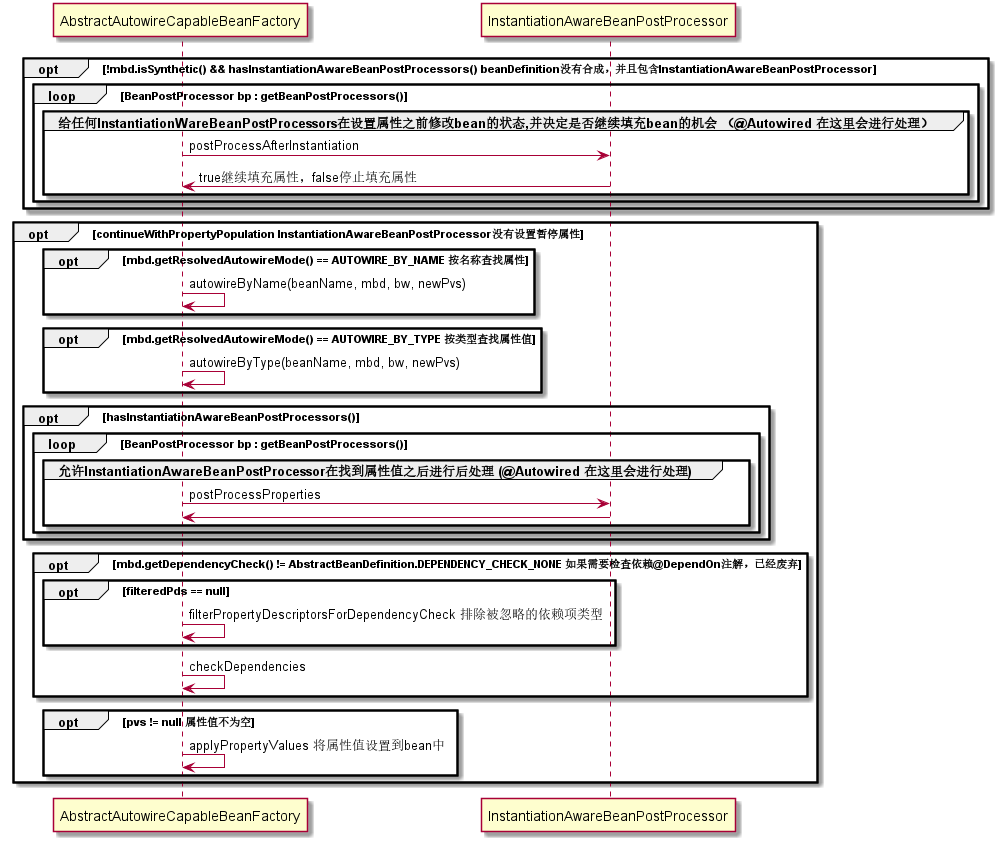
源码注释
    /**
     * Populate the bean instance in the given BeanWrapper with the property values
     * from the bean definition.
     * 填充bean的属性
     * @param beanName the name of the bean   bean的名称
     * @param mbd the bean definition for the bean 合并后的Bean的定义
     * @param bw the BeanWrapper with bean instance   beanWrapper的对象
     */
    @SuppressWarnings("deprecation")  // for postProcessPropertyValues
    protected void populateBean(String beanName, RootBeanDefinition mbd, @Nullable BeanWrapper bw) {
        if (bw == null) {
            if (mbd.hasPropertyValues()) {
                throw new BeanCreationException(
                        mbd.getResourceDescription(), beanName, "Cannot apply property values to null instance");
            }
            else {
                // Skip property population phase for null instance.
                // 跳过没有属性,null实例
                return;
            }
        }

        // Give any InstantiationAwareBeanPostProcessors the opportunity to modify the
        // state of the bean before properties are set. This can be used, for example,
        // to support styles of field injection.
        //给任何InstantiationWareBeanPostProcessors在设置属性之前修改bean的状态的机会。
        // 例如,这可用于支持属性注入
        boolean continueWithPropertyPopulation = true;
        //InstantiationWareBeanPostProcessors  可以控制是否继续填充bean
        if (!mbd.isSynthetic() && hasInstantiationAwareBeanPostProcessors()) {
            for (BeanPostProcessor bp : getBeanPostProcessors()) {
                if (bp instanceof InstantiationAwareBeanPostProcessor) {
                    InstantiationAwareBeanPostProcessor ibp = (InstantiationAwareBeanPostProcessor) bp;
                    if (!ibp.postProcessAfterInstantiation(bw.getWrappedInstance(), beanName)) {
                        continueWithPropertyPopulation = false;
                        break;
                    }
                }
            }
        }

        if (!continueWithPropertyPopulation) {
            return;
        }

        PropertyValues pvs = (mbd.hasPropertyValues() ? mbd.getPropertyValues() : null);

        if (mbd.getResolvedAutowireMode() == AUTOWIRE_BY_NAME || mbd.getResolvedAutowireMode() == AUTOWIRE_BY_TYPE) {
            MutablePropertyValues newPvs = new MutablePropertyValues(pvs);
            // Add property values based on autowire by name if applicable.
            if (mbd.getResolvedAutowireMode() == AUTOWIRE_BY_NAME) {
                //根据名称自动注入
                autowireByName(beanName, mbd, bw, newPvs);
            }
            // Add property values based on autowire by type if applicable.
            if (mbd.getResolvedAutowireMode() == AUTOWIRE_BY_TYPE) {
                //根据类型自动注入
                autowireByType(beanName, mbd, bw, newPvs);
            }
            pvs = newPvs;
        }

        boolean hasInstAwareBpps = hasInstantiationAwareBeanPostProcessors();
        boolean needsDepCheck = (mbd.getDependencyCheck() != AbstractBeanDefinition.DEPENDENCY_CHECK_NONE);

        PropertyDescriptor[] filteredPds = null;
        if (hasInstAwareBpps) {
            //有InstantiationAwareBeanPostProcessors 对象
            if (pvs == null) {
                pvs = mbd.getPropertyValues();
            }
            for (BeanPostProcessor bp : getBeanPostProcessors()) {
                if (bp instanceof InstantiationAwareBeanPostProcessor) {
                    InstantiationAwareBeanPostProcessor ibp = (InstantiationAwareBeanPostProcessor) bp;
                    PropertyValues pvsToUse = ibp.postProcessProperties(pvs, bw.getWrappedInstance(), beanName);
                    if (pvsToUse == null) {
                        if (filteredPds == null) {
                            filteredPds = filterPropertyDescriptorsForDependencyCheck(bw, mbd.allowCaching);
                        }
                        pvsToUse = ibp.postProcessPropertyValues(pvs, filteredPds, bw.getWrappedInstance(), beanName);
                        if (pvsToUse == null) {
                            return;
                        }
                    }
                    pvs = pvsToUse;
                }
            }
        }
        if (needsDepCheck) {
            if (filteredPds == null) {
                filteredPds = filterPropertyDescriptorsForDependencyCheck(bw, mbd.allowCaching);
            }
            //检查依赖Dependency-check
            checkDependencies(beanName, mbd, filteredPds, pvs);
        }

        if (pvs != null) {
            //将属性值设置到Bean中
            applyPropertyValues(beanName, mbd, bw, pvs);
        }
    }
评论
登录后参与技术讨论,分享你的经验与见解。
登录 / 注册暂无评论