PyTorch之前向传播函数自动调用forward

文章目录
参考:1. pytorch学习笔记(九):PyTorch结构介绍
2.pytorch学习笔记(七):pytorch hook 和 关于pytorch backward过程的理解
3.Pytorch入门学习(三):Neural Networks
4.forward
神经网络的典型处理如下所示:
1. 定义可学习参数的网络结构(堆叠各层和层的设计);
2. 数据集输入;
3. 对输入进行处理(由定义的网络层进行处理),主要体现在网络的前向传播;
4. 计算loss ,由Loss层计算;
5. 反向传播求梯度;
6. 根据梯度改变参数值,最简单的实现方式(SGD)为:
weight = weight - learning_rate * gradient
下面是利用PyTorch定义深度网络层(Op)示例:
class FeatureL2Norm(torch.nn.Module):
def __init__(self):
super(FeatureL2Norm, self).__init__()
def forward(self, feature):
epsilon = 1e-6
# print(feature.size())
# print(torch.pow(torch.sum(torch.pow(feature,2),1)+epsilon,0.5).size())
norm = torch.pow(torch.sum(torch.pow(feature, 2),1)+epsilon,0.5).unsqueeze(1).expand_as(feature)
return torch.div(feature,norm)
class FeatureRegression(nn.Module):
def __init__(self, output_dim=6, use_cuda=True):
super(FeatureRegression, self).__init__()
self.conv = nn.Sequential(
nn.Conv2d( 225, 128, kernel_size=7, padding=0),
nn.BatchNorm2d( 128),
nn.ReLU(inplace=True),
nn.Conv2d( 128, 64, kernel_size=5, padding=0),
nn.BatchNorm2d( 64),
nn.ReLU(inplace=True),
)
self.linear = nn.Linear(64 * 5 * 5, output_dim)
if use_cuda:
self.conv.cuda()
self.linear.cuda()
def forward(self, x):
x = self.conv(x)
x = x.view(x.size( 0), -1)
x = self.linear(x)
return x
由上例代码可以看到,不论是在定义网络结构还是定义网络层的操作(Op),均需要定义forward函数,下面看一下PyTorch官网对PyTorch的forward方法的描述:
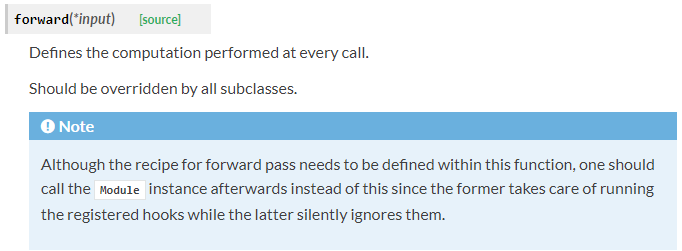
那么调用forward方法的具体流程是什么样的呢?具体流程是这样的:
以一个Module为例:
1. 调用module的call方法
2. module的call里面调用module的forward方法
3. forward里面如果碰到Module的子类,回到第1步,如果碰到的是Function的子类,继续往下
4. 调用Function的call方法
5. Function的call方法调用了Function的forward方法。
6. Function的forward返回值
7. module的forward返回值
8. 在module的call进行forward_hook操作,然后返回值
上述中“调用module的call方法”是指nn.Module 的__call__方法。定义__call__方法的类可以当作函数调用,具体参考Python的面向对象编程。也就是说,当把定义的网络模型model当作函数调用的时候就自动调用定义的网络模型的forward方法。nn.Module 的__call__方法部分源码如下所示:
def __call__(self, *input, **kwargs):
result = self.forward(*input, **kwargs)
for hook in self._forward_hooks.values():
#将注册的hook拿出来用
hook_result = hook( self, input, result)
...
return result
可以看到,当执行model(x)的时候,底层自动调用forward方法计算结果。具体示例如下:
class Function:
def __init__(self):
...
def forward(self, inputs):
...
return outputs
def backward(self, grad_outs):
...
return grad_ins
def _backward(self, grad_outs):
hooked_grad_outs = grad_outs
for hook in hook_in_outputs:
hooked_grad_outs = hook(hooked_grad_outs)
grad_ins = self.backward(hooked_grad_outs)
hooked_grad_ins = grad_ins
for hook in hooks_in_module:
hooked_grad_ins = hook(hooked_grad_ins)
return hooked_grad_ins
model = LeNet()
y = model(x)
如上则调用网络模型定义的forward方法。
评论
登录后参与技术讨论,分享你的经验与见解。
登录 / 注册暂无评论