Go Sync.Pool 背后的想法

文章目录
我最近在一个项目中遇到了垃圾回收问题。大量对象被重复分配,并导致 GC 的巨大工作量。使用 sync.Pool,我能够减少分配和 GC 工作负载。
什么是 sync.Pool?
Go 1.3 版本的亮点之一是同步池。它是 sync 包下的一个组件,用于创建自我管理的临时检索对象池。
为什么要使用 sync.Pool?
我们希望尽可能减少 GC 开销。频繁的内存分配和回收会给 GC 带来沉重的负担。sync.Poll 可以缓存暂时不使用的对象,并在下次需要时直接使用它们(无需重新分配)。这可能会减少 GC 工作负载并提高性能。
怎么使用 sync.Pool?
首先,您需要设置新函数。当池中没有缓存对象时将使用此函数。之后,您只需要使用 Get 和 Put 方法来检索和返回对象。另外,池在第一次使用后绝对不能复制。
由于 New 函数类型是 func() interface{},Get 方法返回一个 interface{}。为了得到具体对象,你需要做一个类型断言。
`// A dummy struct`
`type Person struct {`
 `Name string`
`}`
`// Initializing pool`
`var personPool = sync.Pool{`
 `// New optionally specifies a function to generate`
 `// a value when Get would otherwise return nil.`
 `New: func() interface{} { return new(Person) },`
`}`
`// Main function`
`func main() {`
 `// Get hold of an instance`
 `newPerson := personPool.Get().(*Person)`
 `// Defer release function`
 `// After that the same instance is`
 `// reusable by another routine`
 `defer personPool.Put(newPerson)`
 `// Using the instance`
 `newPerson.Name = "Jack"`
`}`
基准测试
`type Person struct {`
 `Age int`
`}`
`var personPool = sync.Pool{`
 `New: func() interface{} { return new(Person) },`
`}`
`func BenchmarkWithoutPool(b *testing.B) {`
 `var p *Person`
 `b.ReportAllocs()`
 `b.ResetTimer()`
 `for i := 0; i < b.N; i++ {`
 `for j := 0; j < 10000; j++ {`
 `p = new(Person)`
 `p.Age = 23`
 `}`
 `}`
`}`
`func BenchmarkWithPool(b *testing.B) {`
 `var p *Person`
 `b.ReportAllocs()`
 `b.ResetTimer()`
 `for i := 0; i < b.N; i++ {`
 `for j := 0; j < 10000; j++ {`
 `p = personPool.Get().(*Person)`
 `p.Age = 23`
 `personPool.Put(p)`
 `}`
 `}`
`}`
测试结果:
`BenchmarkWithoutPool`
`BenchmarkWithoutPool-8   160698 ns/op   80001 B/op   10000 allocs/op`
`BenchmarkWithPool`
`BenchmarkWithPool-8      191163 ns/op       0 B/op       0 allocs/op`
权衡
生活中的一切都是一种权衡。池也有它的性能成本。使用 sync.Pool 比简单的初始化要慢得多。
`func BenchmarkPool(b *testing.B) {`
 `var p sync.Pool`
 `b.RunParallel(func(pb *testing.PB) {`
 `for pb.Next() {`
 `p.Put(1)`
 `p.Get()`
 `}`
 `})`
`}`
`func BenchmarkAllocation(b *testing.B) {`
 `b.RunParallel(func(pb *testing.PB) {`
 `for pb.Next() {`
 `i := 0`
 `i = i`
 `}`
 `})`
`}`
压测结果:
`BenchmarkPool`
`BenchmarkPool-8           283395016          4.40 ns/op`
`BenchmarkAllocation`
`BenchmarkAllocation-8    1000000000         0.344 ns/op`
sync.Pool 是如何工作的?
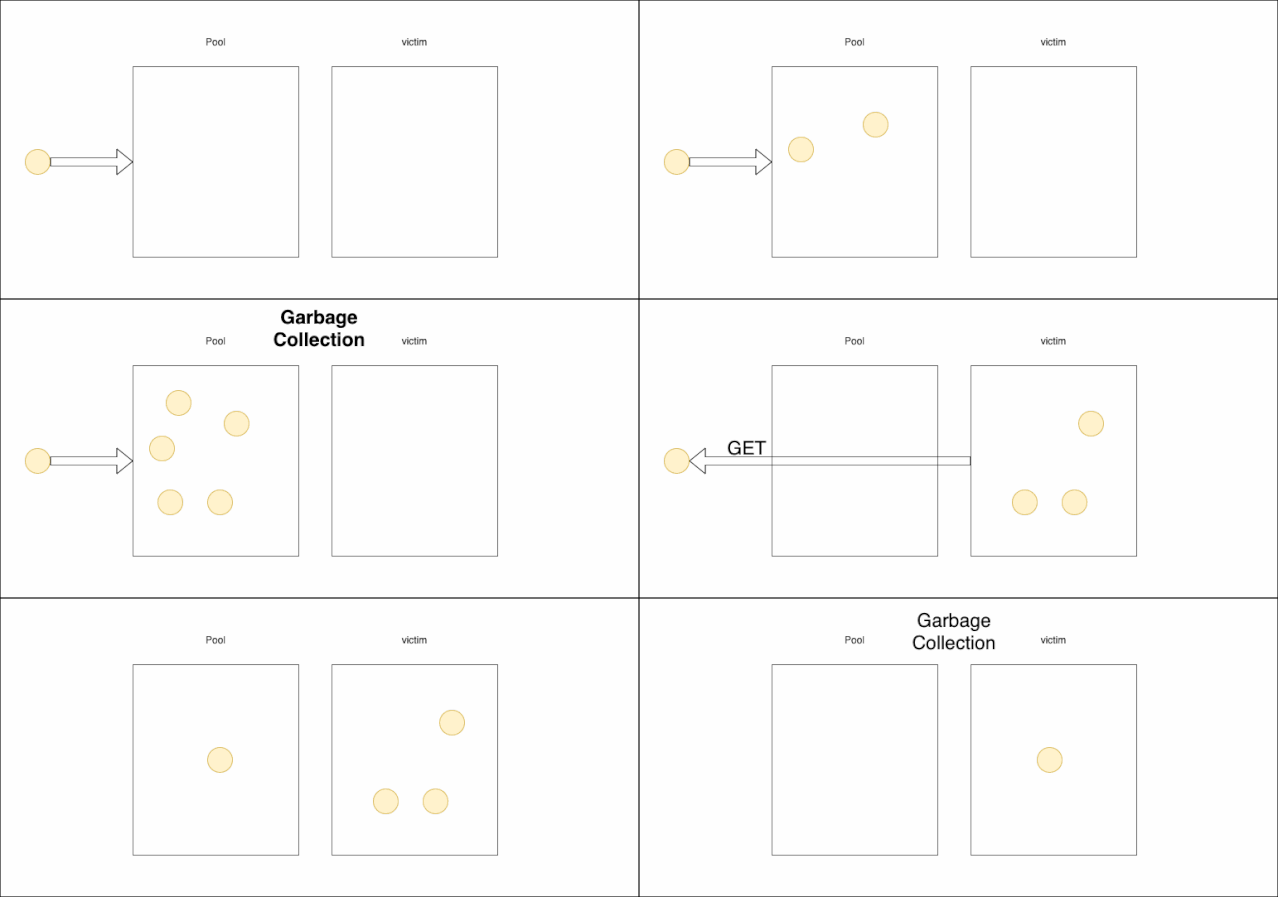
sync.Pool 有两个对象容器: 本地池 (活动) 和受害者缓存 (存档)。
根据 sync/pool.go ,包 init 函数作为清理池的方法注册到运行时。此方法将由 GC 触发。
`func init() {`
 `runtime_registerPoolCleanup(poolCleanup)`
`}`
当 GC 被触发时,受害者缓存中的对象将被收集,然后本地池中的对象将被移动到受害者缓存中。
`func poolCleanup() {`
 `// Drop victim caches from all pools.`
 `for _, p := range oldPools {`
 `p.victim = nil`
 `p.victimSize = 0`
 `}`
 `// Move primary cache to victim cache.`
 `for _, p := range allPools {`
 `p.victim = p.local`
 `p.victimSize = p.localSize`
 `p.local = nil`
 `p.localSize = 0`
 `}`
 `oldPools, allPools = allPools, nil`
`}`
新对象被放入本地池中。调用 Put 方法也会将对象放入本地池中。调用 Get 方法将首先从受害者缓存中获取对象,如果受害者缓存为空,则对象将从本地池中获取。
供你参考,Go 1.12 sync.pool 实现使用基于 mutex 的锁,用于来自多个 Goroutines 的线程安全操作。Go 1.13 引入了一个双链表作为共享池,它删除了 mutex 并改善了共享访问。
结论
当有一个昂贵的对象需要频繁创建时,使用 sync.Pool 是非常有益的。
“
译自:https://medium.com/swlh/go-th...
”

来都来了,点个“再看”再走叭~~

评论
登录后参与技术讨论,分享你的经验与见解。
登录 / 注册暂无评论