sync.Pool源码分析

文章目录
Pool源码分析
type Pool struct {
    noCopy noCopy

    local     unsafe.Pointer // local fixed-size per-P pool, actual type is [P]poolLocal
    localSize uintptr        // size of the local array

    victim     unsafe.Pointer // local from previous cycle
    victimSize uintptr        // size of victims array

    // New optionally specifies a function to generate
    // a value when Get would otherwise return nil.
    // It may not be changed concurrently with calls to Get.
    New func() interface{}
}

// Local per-P Pool appendix.
type poolLocalInternal struct {
    private interface{} // Can be used only by the respective P.
    shared  poolChain   // Local P can pushHead/popHead; any P can popTail.
}- local这里面真正的是[P]poolLocal其中P就是GPM模型中的P,有多少个P数组就有多大,也就是每个P维护了一个本地的poolLocal。
- poolLocal里面维护了一个private一个shared,看名字其实就很明显了,private是给自己用的,而shared的是一个队列,可以给别人用的。注释写的也很清楚,自己可以从队列的头部存然后从头部取,而别的P可以从尾部取。
- victim这个从字面上面也可以知道,幸存者嘛,当进行gc的stw时候,会将local中的对象移到victim中去,也就是说幸存了一次gc
Get方法
func (p *Pool) Get() interface{} {
    if race.Enabled {
        race.Disable()
    }
    l, pid := p.pin()
    x := l.private
    l.private = nil
    if x == nil {
        // Try to pop the head of the local shard. We prefer
        // the head over the tail for temporal locality of
        // reuse.
        x, _ = l.shared.popHead()
        if x == nil {
            x = p.getSlow(pid)
        }
    }
    runtime_procUnpin()
    if race.Enabled {
        race.Enable()
        if x != nil {
            race.Acquire(poolRaceAddr(x))
        }
    }
    if x == nil && p.New != nil {
        x = p.New()
    }
    return x
}
func (p *Pool) getSlow(pid int) interface{} {
    // See the comment in pin regarding ordering of the loads.
    size := runtime_LoadAcquintptr(&p.localSize) // load-acquire
    locals := p.local                            // load-consume
    // Try to steal one element from other procs.
    for i := 0; i < int(size); i++ {
        l := indexLocal(locals, (pid+i+1)%int(size))
        if x, _ := l.shared.popTail(); x != nil {
            return x
        }
    }

    // Try the victim cache. We do this after attempting to steal
    // from all primary caches because we want objects in the
    // victim cache to age out if at all possible.
    size = atomic.LoadUintptr(&p.victimSize)
    if uintptr(pid) >= size {
        return nil
    }
    locals = p.victim
    l := indexLocal(locals, pid)
    if x := l.private; x != nil {
        l.private = nil
        return x
    }
    for i := 0; i < int(size); i++ {
        l := indexLocal(locals, (pid+i)%int(size))
        if x, _ := l.shared.popTail(); x != nil {
            return x
        }
    }

    // Mark the victim cache as empty for future gets don't bother
    // with it.
    atomic.StoreUintptr(&p.victimSize, 0)

    return nil
}
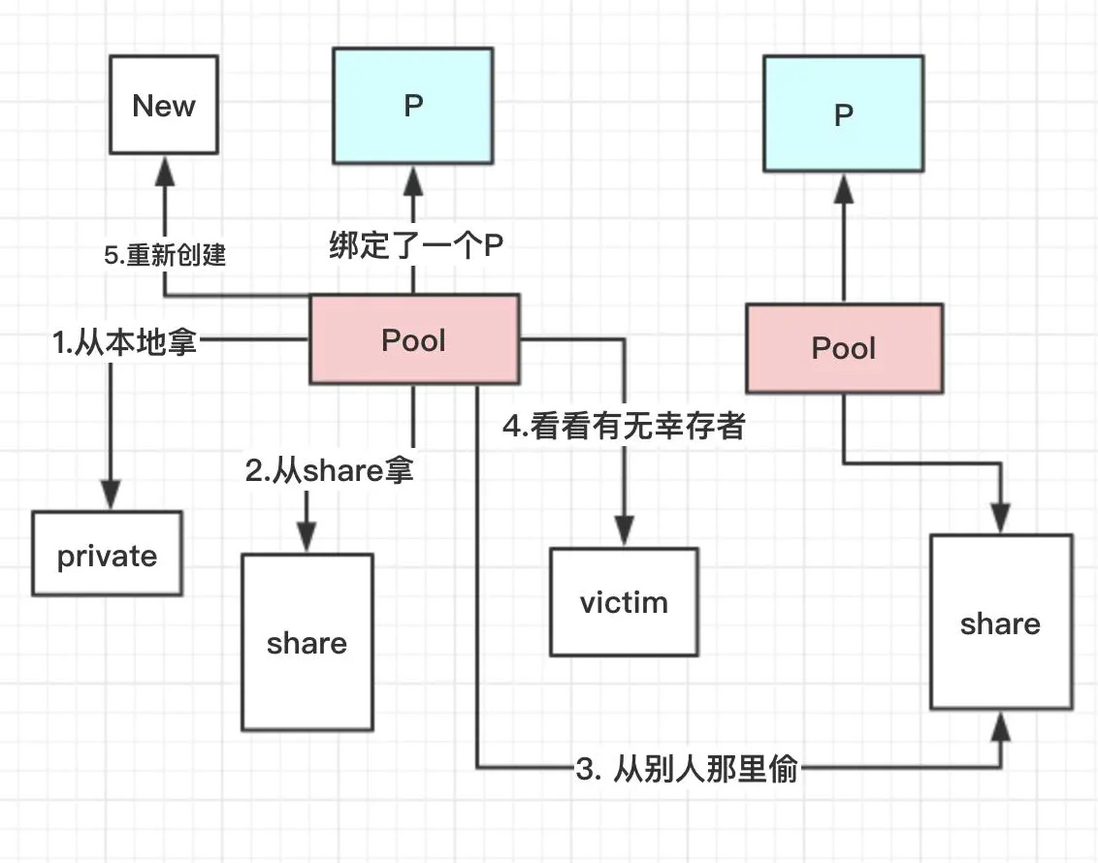
我去掉了其中一些竞态分析的代码,Get的逻辑其实非常清晰。
- 如果 private 不是空的,那就直接拿来用
- 如果 private 是空的,那就先去本地的shared队列里面从头 pop 一个
- 如果本地的 shared 也没有了,那 getSlow 去拿,其实就是去别的P的 shared 里面偷,偷不到回去 victim 幸存者里面找
如果最后都没有,那就只能调用 New 方法创建一个了
Put方法
// Put adds x to the pool.
func (p *Pool) Put(x interface{}) {
    if x == nil {
        return
    }
    if race.Enabled {
        if fastrand()%4 == 0 {
            // Randomly drop x on floor.
            return
        }
        race.ReleaseMerge(poolRaceAddr(x))
        race.Disable()
    }
    l, _ := p.pin()
    if l.private == nil {
        l.private = x
        x = nil
    }
    if x != nil {
        l.shared.pushHead(x)
    }
    runtime_procUnpin()
    if race.Enabled {
        race.Enable()
    }
}
看完Get其实Put就很简单了
- 如果 private 没有,就放在 private
- 如果 private 有了,那么就放到 shared 队列的头部
评论
登录后参与技术讨论,分享你的经验与见解。
登录 / 注册暂无评论