并查集(UnionFind)技巧总结

文章目录
什么是并查集
<span class="colour" style="color:rgb(0, 0, 0)">在计算机科学中,并查集是一种树型的数据结构,用于处理一些不交集(Disjoint Sets)的合并及查询问题。有一个联合-查找算法(Union-find Algorithm)定义了两个用于此数据结构的操作:</span>
- Find:确定元素属于哪一个子集。它可以被用来确定两个元素是否属于同一子集。
- Union:将两个子集合并成同一个集合。
<span class="colour" style="color:rgb(0, 0, 0)">由于支持这两种操作,一个不相交集也常被称为联合-查找数据结构(Union-find Data Structure)或合并-查找集合(Merge-find Set)。</span>
并查集可以解决什么问题
- 组团、配对
- 图的连通性问题
- 集合的个数
- 集合中元素的个数
算法模板
type UnionFind struct { count int parent []int } func ctor(n int) UnionFind { uf := UnionFind{ count: n, parent: make([]int, n), } for i := 0; i < n; i++ { uf.parent[i] = i } return uf } func (uf *UnionFind) find(p int) int { for p != uf.parent[p] { uf.parent[p] = uf.parent[uf.parent[p]] // 路径压缩 p = uf.parent[p] } return p } func (uf *UnionFind) union(p, q int) { rootP, rootQ := uf.find(p), uf.find(q) if rootP == rootQ { return } uf.parent[rootP] = rootQ uf.count-- }实例
<span class="colour" style="color:rgb(0, 0, 0)">547. 朋友圈</span>
<span class="colour" style="color:rgb(0, 0, 0)">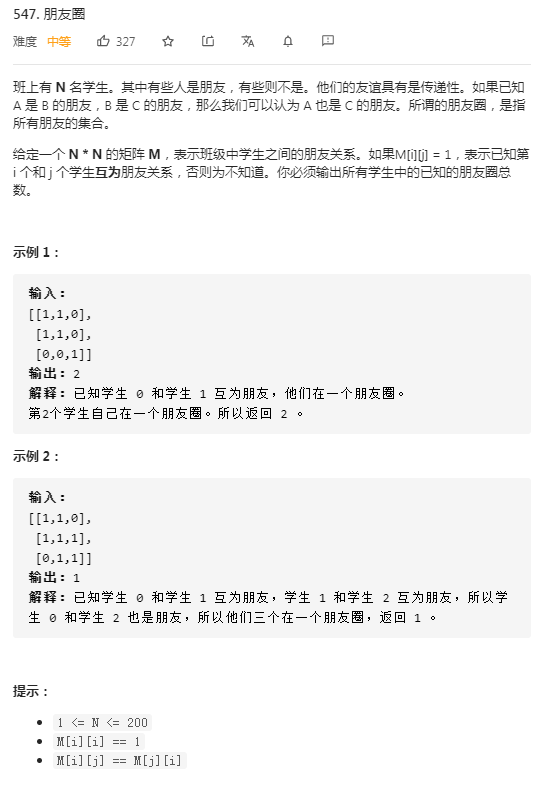 </span>
<span class="colour" style="color:rgb(0, 0, 0)">题目分析:</span>
<span class="colour" style="color:rgb(0, 0, 0)">题目求的是有多少个朋友圈,也就是求有集合个数,可用并查集解决。</span>
<span class="colour" style="color:rgb(0, 0, 0)">两重遍历所有学生,判断俩俩是否为朋友,如为朋友将加入到集合中。这里可以通过遍历二维矩阵的右半边即可,可降低遍历数量,从而降低时间复杂度。</span>
<span class="colour" style="color:rgb(0, 0, 0)">代码实现:</span>
func findCircleNum(M [][]int) int { n := len(M) uf := ctor(n) // 遍历学生 i, j ,if M[i][j]==1 加入集 for i := 0; i < n; i++ { for j := i + 1; j < n; j++ { if M[i][j] == 1 { uf.union(i, j) } } } // 再返回有多少个集合 return uf.count } type UnionFind struct { parents []int count int } func ctor(n int) UnionFind { uf := UnionFind{ parents: make([]int, n), count: n, } for i := 0; i < n; i++ { uf.parents[i] = i } return uf } func (uf *UnionFind) find(p int) int { for p != uf.parents[p] { uf.parents[p] = uf.parents[uf.parents[p]] p = uf.parents[p] } return p } func (uf *UnionFind) union(p, q int) bool { rootP, rootQ := uf.find(p), uf.find(q) if rootP == rootQ { return false } uf.parents[rootP] = rootQ uf.count-- return true }<span class="colour" style="color:rgb(0, 0, 0)">复杂度分析:</span>
- 时间复杂度:O(n2)O(n2)。两重遍历用时 O(n2)O(n2) ,
uf.union和uf.find的时间复杂度为 O(1)O(1) ,所以总的时间复杂度为 O(n2)O(n2)。 - 空间复杂度:O(n)O(n)。需要一个 O(n)O(n) 大小的空间。
<span class="colour" style="color:rgb(0, 0, 0)">200. 岛屿数量</span>
<span class="colour" style="color:rgb(0, 0, 0)">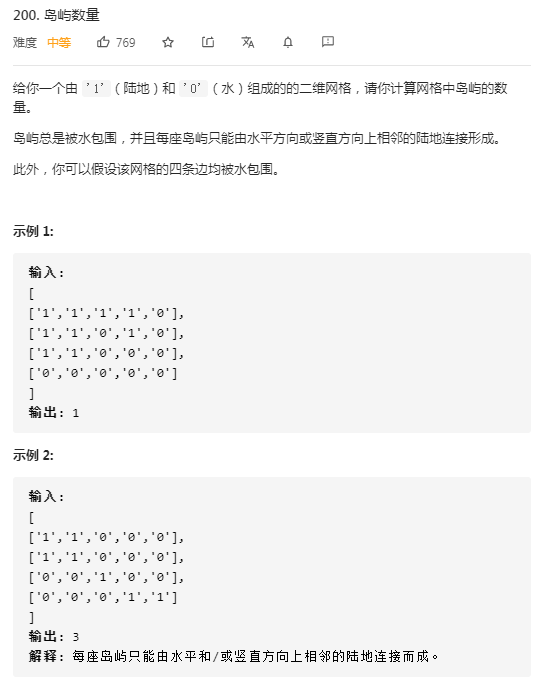 </span>
<span class="colour" style="color:rgb(0, 0, 0)">题目分析:</span>
<span class="colour" style="color:rgb(0, 0, 0)">题目求的是岛屿数量,即集合个数,可用并查集解决。</span>
<span class="colour" style="color:rgb(0, 0, 0)">题目可抽象为遍历所有网格 (i, j),如果是陆地((i, j) == '1'),则把其右边的陆地((i+1, j) == '1')和下边的陆地((i, j+1) == '1')合并到一起;如是水((i, j) == '0'),则把其合并到一个哨兵集合里。最后返回 集合个数 - 1。</span>
<span class="colour" style="color:rgb(0, 0, 0)">注:这里关键是对于水的处理,把其合并到一个哨兵集合里,让水不会单独存在,从而干扰岛屿个数的判断。</span>
<span class="colour" style="color:rgb(0, 0, 0)">代码实现:</span>
func numIslands(grid [][]byte) int { rows := len(grid) if rows == 0 { return 0 } cols := len(grid[0]) if cols == 0 { return 0 } uf := ctor(rows*cols + 1) guard := rows * cols // 哨兵:用于作为 '0' 的集合 directions := [][]int{[]int{0, 1}, []int{1, 0}} for i := 0; i < rows; i++ { for j := 0; j < cols; j++ { index := i*cols + j if grid[i][j] == '1' { for _, direction := range directions { newI, newJ := i+direction[0], j+direction[1] if newI < rows && newJ < cols && grid[newI][newJ] == '1' { newIndex := newI*cols + newJ uf.union(index, newIndex) } } } else { uf.union(guard, index) } } } return uf.count - 1 } type UnionFind struct { parents []int count int } func ctor(n int) UnionFind { uf := UnionFind{parents: make([]int, n), count: n} for i := 0; i < n; i++ { uf.parents[i] = i } return uf } func (uf *UnionFind) find(p int) int { for p != uf.parents[p] { uf.parents[p] = uf.parents[uf.parents[p]] p = uf.parents[p] } return p } func (uf *UnionFind) union(p, q int) bool { rootP, rootQ := uf.find(p), uf.find(q) if rootP == rootQ { return false } uf.parents[rootP] = rootQ uf.count-- return true }<span class="colour" style="color:rgb(0, 0, 0)">复杂度分析:</span>
- 时间复杂度:O(n∗m)O(n∗m),其中
n和m分别表示二维数组的行数和列数。 - 空间复杂度:O(n∗m)O(n∗m)。并查集需要
n * m大小的数组空间。
<span class="colour" style="color:rgb(0, 0, 0)">130. 被围绕的区域</span>
<span class="colour" style="color:rgb(0, 0, 0)">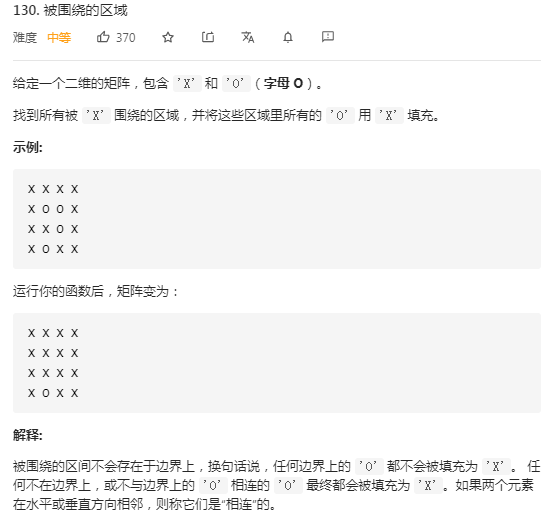 </span>
<span class="colour" style="color:rgb(0, 0, 0)">题目分析:</span>
<span class="colour" style="color:rgb(0, 0, 0)">题目可理解为把边界上的 'O' 保留,其他都填充为 'X' ,可以把边界上的 'O' 作为一个集合,不是这个集合的填充为 'X' ,因此可使用并查集解决。</span>
- 遍历边界上的点,把
'O'合并到一个哨兵集合里。 - 遍历二维矩阵里的点,把
'O'的右和下合并到一起。 - 遍历二维矩阵,把不在哨兵集合里的全部填充为
'X'
<span class="colour" style="color:rgb(0, 0, 0)">代码实现:</span>
func solve(board [][]byte) { n := len(board) if n == 0 { return } m := len(board[0]) if m == 0 { return } uf := ctor(n*m + 1) guard := n * m directions := [][]int{[]int{0, 1}, []int{1, 0}} getIndex := func(i, j int) int { return i*m + j } // 1. 遍历边界上的点,把 'O' 合并到一个哨兵集合里。 for j := 0; j < m; j++ { if board[0][j] == 'O' { uf.union(getIndex(0, j), guard) } if board[n-1][j] == 'O' { uf.union(getIndex(n-1, j), guard) } } for i := 0; i < n; i++ { if board[i][0] == 'O' { uf.union(getIndex(i, 0), guard) } if board[i][m-1] == 'O' { uf.union(getIndex(i, m-1), guard) } } // 2. 遍历二维矩阵里的点,把 ```'O'``` 的右和下合并到一起。 for i := 0; i < n; i++ { for j := 0; j < m; j++ { if board[i][j] == 'O' { for _, direction := range directions { newI, newJ := i+direction[0], j+direction[1] if newI < n && newJ < m && board[newI][newJ] == 'O' { uf.union(getIndex(newI, newJ), getIndex(i, j)) } } } } } // 3. 遍历二维矩阵,把不在哨兵集合里的全部填充为 'X' for i := 0; i < n; i++ { for j := 0; j < m; j++ { if !uf.isConnect(getIndex(i, j), guard) { board[i][j] = 'X' } } } } type UnionFind struct { parents []int count int } func ctor(n int) UnionFind { uf := UnionFind{ parents: make([]int, n), count: n, } for i := 0; i < n; i++ { uf.parents[i] = i } return uf } func (uf *UnionFind) find(p int) int { for p != uf.parents[p] { uf.parents[p] = uf.parents[uf.parents[p]] p = uf.parents[p] } return p } func (uf *UnionFind) union(p, q int) bool { rootP, rootQ := uf.find(p), uf.find(q) if rootP == rootQ { return false } uf.parents[rootP] = rootQ uf.count-- return true } func (uf *UnionFind) isConnect(p, q int) bool { return uf.find(p) == uf.find(q) }<span class="colour" style="color:rgb(0, 0, 0)">复杂度分析:</span>
- 时间复杂度:O(n2)O(n2),其中
n和m分别表示二维数组的行数和列数。 - 空间复杂度:O(n2)O(n2)。并查集需要
n * m大小的数组空间。
总结
- 要熟练掌握并查集的模板,要能够快速写出来。
- 要掌握并查集的应用场景。例如组团、配对、图的连通性问题、集合个数、集合中元素的个数等。
- 对于二维的问题转一维解决,例如
200. 岛屿数量和130. 被围绕的区域。 - 找出元素间的“配对”关系是解决问题的关键。例如二维数组,找当前位置与其右和其下配对。例如
200. 岛屿数量和130. 被围绕的区域。
评论
登录后参与技术讨论,分享你的经验与见解。
登录 / 注册暂无评论